


Decision Making Under Uncertainty: 5 Decision Rules
Sometimes you have to choose, but you have no probabilities. You know the possible outcomes. You just cannot say how likely each one is. This is called decision making under uncertainty. When this happens, you use a decision rule. Each rule shows a different attitude to risk.
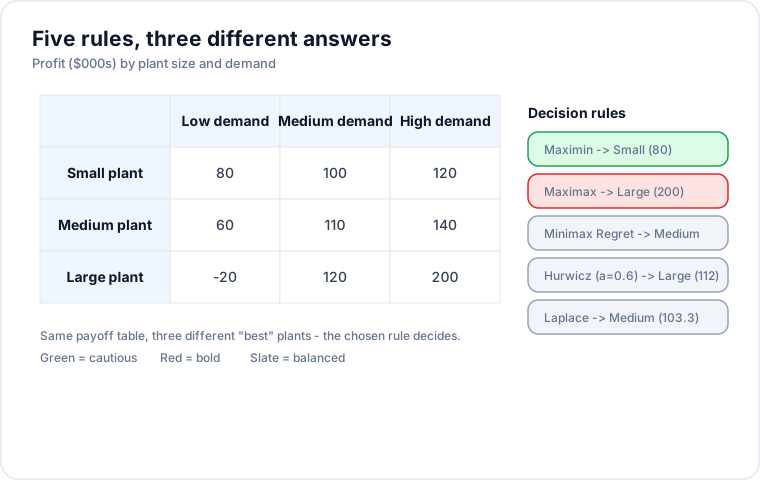
This page works through the five classic rules on one simple example. They are Maximin, Maximax, Minimax Regret, Hurwicz, and Laplace. The same table can point to three different choices. The rule you pick depends on how cautious or bold you want to be.
The example: how big a plant to build
You want to build a new plant. You can build it small, medium, or large. Your profit depends on customer demand, which could be low, medium, or high. You cannot predict the demand. Here is the profit for each plan, in thousands of dollars.
| Plan | Low demand | Medium demand | High demand |
|---|---|---|---|
| Small plant | 80 | 100 | 120 |
| Medium plant | 60 | 110 | 140 |
| Large plant | -20 | 120 | 200 |
Maximin: play it safe
Maximin looks at the worst case for each plan. Then it picks the plan with the best worst case. It suits a careful decision maker.
- Small plant: worst case is 80.
- Medium plant: worst case is 60.
- Large plant: worst case is -20.
The best of these worst cases is 80. So Maximin chooses the small plant.
Maximax: aim for the best
Maximax looks at the best case for each plan. Then it picks the plan with the highest best case. It suits an optimist.
- Small plant: best case is 120.
- Medium plant: best case is 140.
- Large plant: best case is 200.
The highest is 200. So Maximax chooses the large plant.
Minimax Regret: avoid kicking yourself
Regret is what you lose by not picking the best plan for a given demand. First, find the best profit in each demand column. Then subtract each profit from that best value. That gives the regret table.
| Plan | Low | Medium | High | Worst regret |
|---|---|---|---|---|
| Small plant | 0 | 20 | 80 | 80 |
| Medium plant | 20 | 10 | 60 | 60 |
| Large plant | 100 | 0 | 0 | 100 |
Now look at the worst regret in each row. Pick the plan with the smallest worst regret. That is 60. So Minimax Regret chooses the medium plant.
Hurwicz: balance hope and caution
The Hurwicz rule mixes the best case and the worst case. You choose a number called alpha, between 0 and 1. Alpha is your level of optimism. The score is alpha times the best case, plus (1 minus alpha) times the worst case. Here we use alpha = 0.6.
- Small plant: 0.6 x 120 + 0.4 x 80 = 104.
- Medium plant: 0.6 x 140 + 0.4 x 60 = 108.
- Large plant: 0.6 x 200 + 0.4 x (-20) = 112.
The highest score is 112. So Hurwicz chooses the large plant.
Laplace: treat all outcomes as equal
The Laplace rule assumes every demand is equally likely. So it just takes the average profit for each plan. Then it picks the highest average.
- Small plant: (80 + 100 + 120) / 3 = 100.
- Medium plant: (60 + 110 + 140) / 3 = 103.33.
- Large plant: (-20 + 120 + 200) / 3 = 100.
The highest average is 103.33. So Laplace chooses the medium plant.
Which rule should you use?
There is no single right answer. Each rule fits a different mood.
- Use Maximin when a bad outcome would hurt you badly.
- Use Maximax when you can chase the upside.
- Use Minimax Regret when you hate missing out.
- Use Hurwicz when you want to set your own level of optimism.
- Use Laplace when every outcome feels about as likely.
If you can estimate real probabilities, you should. Then you can use expected value and a full decision tree instead. See Decision Criteria for that next step.
The SpiceLogic Decision Tree Analyzer applies all five rules for you. You enter the payoff table once. The software shows each rule's choice side by side.