


Utility Functions: Bernoulli and Exponential Explained
Money is not the whole story when you make a risky choice. A sure $500 often feels safer than a coin flip for $0 or $1,000, even though both average $500. A utility function captures this feeling. It turns dollars into value, the way you actually feel the dollars.
This page explains two common utility functions. One is the Bernoulli (logarithmic) function. The other is the exponential function. We also show how to find a certainty equivalent and a risk premium. Every number below is worked out in full.
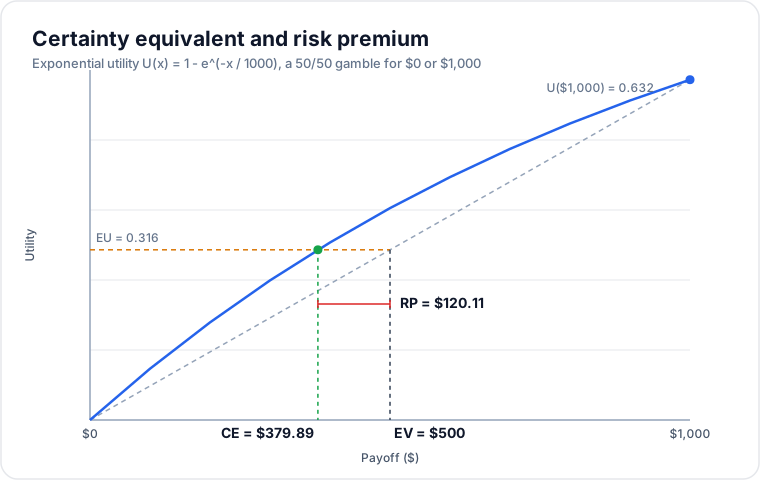
Why the curve bends
For most people, each extra dollar matters a little less than the one before. Your first $1,000 can change your life. Your millionth $1,000 barely registers. This is called diminishing marginal utility. It makes the utility curve bend downward. A bent (concave) curve means you are risk averse. You prefer a sure thing over a fair gamble.
The Bernoulli (logarithmic) utility function
Daniel Bernoulli suggested using the logarithm of wealth as utility.
U(x) = ln(x)
The logarithm grows fast at first, then slows down. That matches diminishing marginal utility. It is a simple, classic way to model a risk-averse person.
The exponential utility function
The exponential function is the other common choice.
U(x) = 1 - e^(-x / R)
Here R is the risk tolerance. A small R means you are very cautious. A large R means you care less about risk. This function has constant absolute risk aversion. That means your view of a $100 gamble does not change as your wealth grows.
A worked example
Say you face a fair gamble. You have a 50% chance of $0 and a 50% chance of $1,000. The average payoff, called the expected value, is $500. Let us use the exponential function with R = 1,000.
First, find the utility of each outcome.
- U($0) = 1 - e^(0) = 0.
- U($1,000) = 1 - e^(-1) = 0.6321.
Now find the expected utility. This is the average of the two utilities.
EU = 0.5 x 0 + 0.5 x 0.6321 = 0.3161
The certainty equivalent
The certainty equivalent (CE) is the sure amount that feels just as good as the gamble. To find it, ask which dollar amount gives a utility of 0.3161. We solve U(CE) = 0.3161.
1 - e^(-CE / 1000) = 0.3161, so CE = $379.89
So a guaranteed $379.89 feels as good to you as this gamble. Even though the gamble averages $500, you would happily take $379.89 for sure instead.
The risk premium
The risk premium is the price you pay for safety. It is the gap between the average payoff and the certainty equivalent.
Risk premium = expected value - certainty equivalent = $500 - $379.89 = $120.11
You give up $120.11 of average value to avoid the risk. That number is a clear measure of how risk averse you are.
Doing this in software
You do not have to solve these by hand. Rational Will fits a utility function to your own choices. Then it computes the certainty equivalent and risk premium for any decision. You can read more in these guides: utility functions, the certainty equivalent, and the risk premium.