


Introduction to the Bayesian Tools
Rational Will gives you two tools for Bayesian analysis. One is the Bayesian Network. The other is Diachronic Interpretation, which we usually just call Bayesian Inference. Both rest on the same simple idea. You start with what you already believe, then you update that belief as new evidence comes in.
That idea matters because real life rarely hands you proof all at once. You get one clue, then another, then another, and your confidence shifts a little each time. A doctor sees a symptom and suspects a condition. A test result comes back, and the suspicion goes up or down. Bayesian analysis is just a clean, honest way to do that math instead of guessing.
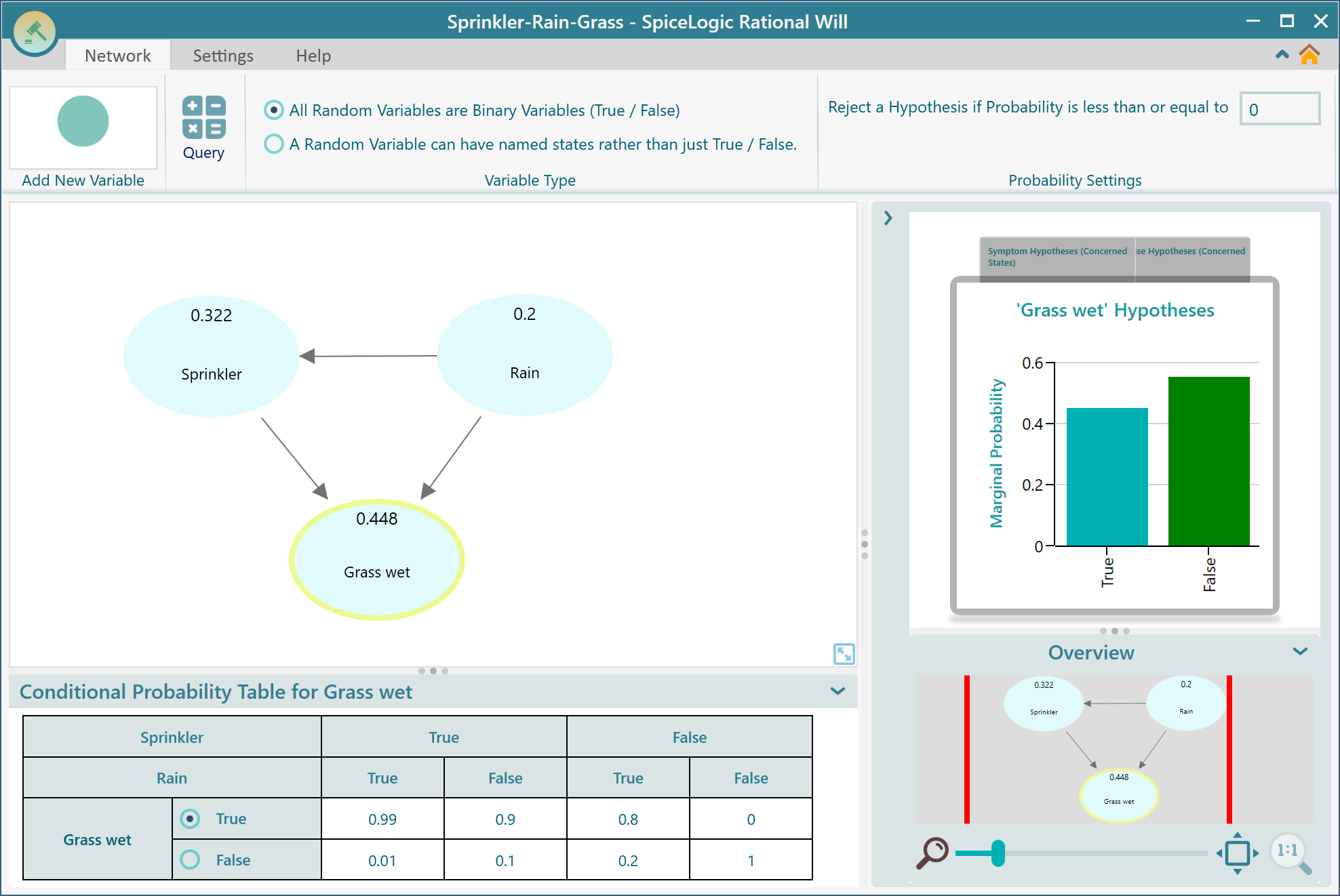
The Bayesian Network is the visual, diagram-based tool. You draw nodes, where each node stands for a random variable, and you connect the nodes to show how they depend on each other. Say you have a node for "It rained last night", a node for "The grass is wet", and a node for "The sprinkler was on". Wet grass depends on both rain and the sprinkler, so you draw an arrow from each cause into the wet-grass node. Once the network and its probabilities are in place, you can ask it questions. For example: if the grass is wet, how likely is it that it rained? The network works out the answer for you.
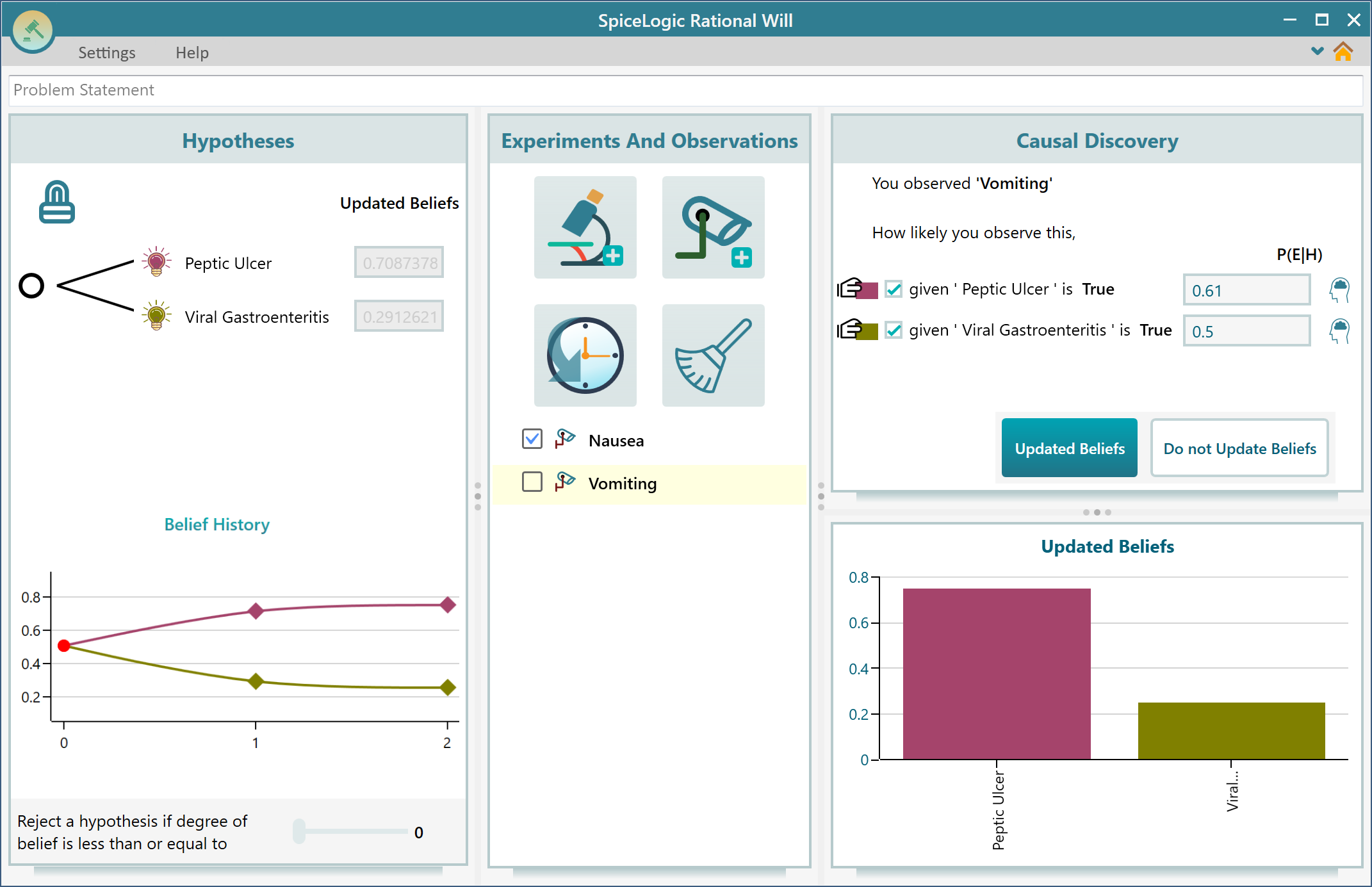
The Bayesian Inference tool takes a step-by-step approach instead of a diagram. First you list your hypotheses, the possible explanations you are weighing. Then you add your experiments and observations one at a time. For each one, you set how likely that observation would be under each hypothesis. As you feed in each new piece of evidence, the tool recalculates how strongly you should believe each hypothesis. So this tool is built for collecting evidence one piece at a time and watching your beliefs update as it arrives.
In short: reach for the Bayesian Network when you want to model how several variables push on each other and see the whole picture as a diagram. Reach for Bayesian Inference when you have a clear list of competing explanations and you want to test them as the evidence comes in.
Here is a screenshot of a typical Bayesian Network model.
And here is a screenshot of a typical Bayesian Inference model.
To learn more about each tool, follow the links below.