


Cost-Effectiveness Analysis: ICER, CE Plane, Dominance
Cost-effectiveness analysis (CEA) helps you compare health treatments. It looks at two things at once: how much a treatment costs, and how much health it gives. Health gain is often measured in QALYs. A QALY is one year of life in full health.
The question is simple. Are the extra health gains worth the extra cost? This page shows how to answer it. We cover the ICER, the cost-effectiveness plane, dominance, the efficiency frontier, and net monetary benefit. We use one worked example all the way through.
The ICER formula
ICER stands for incremental cost-effectiveness ratio. It is the extra cost you pay per extra QALY when you switch from one option to another.
ICER = (cost of new option - cost of old option) / (QALYs of new option - QALYs of old option)
A lower ICER is better. It means you buy each extra year of healthy life more cheaply.
The example: four strategies
Say you have four treatment strategies: A, B, C, and D. Here are their costs and QALYs.
| Strategy | Cost | QALYs |
|---|---|---|
| A | $10,000 | 1.0 |
| B | $45,000 | 1.5 |
| C | $35,000 | 2.0 |
| D | $40,000 | 2.5 |
Strong dominance: drop the clearly bad options
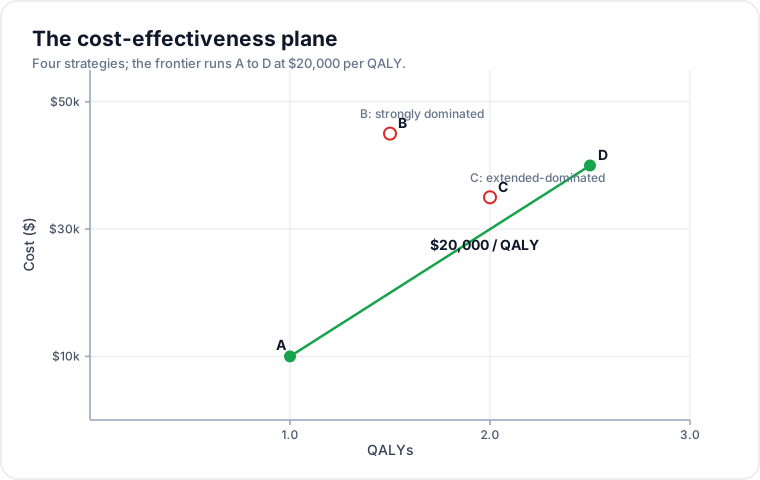
One option strongly dominates another when it costs less and gives more health. Look at B. It costs $45,000 for 1.5 QALYs. Option D costs less, $40,000, and gives more, 2.5 QALYs. So D beats B on both counts. B is strongly dominated. Remove it.
Extended dominance: a subtler trap
Now compare the rest. Extended dominance is harder to spot. An option is extended-dominated when its ICER is higher than the ICER of a better option. People miss this one most often.
- C versus A: ($35,000 - $10,000) / (2.0 - 1.0) = $25,000 per QALY.
- D versus C: ($40,000 - $35,000) / (2.5 - 2.0) = $10,000 per QALY.
Moving from A to C costs $25,000 per QALY. But moving past C to D costs only $10,000 per QALY. So paying for C on its own is poor value. C is extended-dominated. Remove it too.
The efficiency frontier
After removing B and C, two options remain: A and D. These form the efficiency frontier. The frontier is the set of options that give the best health for the money.
The ICER of D versus A is ($40,000 - $10,000) / (2.5 - 1.0) = $20,000 per QALY. So each extra healthy year from D costs $20,000.
It helps to picture this on the cost-effectiveness plane. The horizontal axis shows extra health (QALYs). The vertical axis shows extra cost. Each strategy is a point. The frontier connects the best points, from low cost and low health up to high cost and high health. Good options sit on this line. Dominated options sit above it, where you pay more for less.
Willingness to pay and net monetary benefit
Is $20,000 per QALY a good deal? That depends on your willingness-to-pay threshold. This is the most you will pay for one QALY. Many health systems use a threshold near $50,000 to $100,000 per QALY.
Net monetary benefit (NMB) turns cost and health into a single number.
NMB = (threshold x QALYs) - cost
Using a threshold of $100,000 per QALY:
| Strategy | Net monetary benefit |
|---|---|
| A | $90,000 |
| B | $105,000 |
| C | $165,000 |
| D | $210,000 |
Strategy D has the highest net monetary benefit, $210,000. So at this threshold, D is the best choice.
Doing this in software
You can work this out by hand for four options. Real health models have many more, often over many years. The SpiceLogic Decision Tree Analyzer builds Markov cost-effectiveness models for you. It finds the dominated options, draws the cost-effectiveness plane, and reports the ICER and net monetary benefit. It is a more affordable alternative to TreeAge. See the cost-effectiveness plane guide for a full walk-through.