


 NuGet
NuGet
Table authoring service
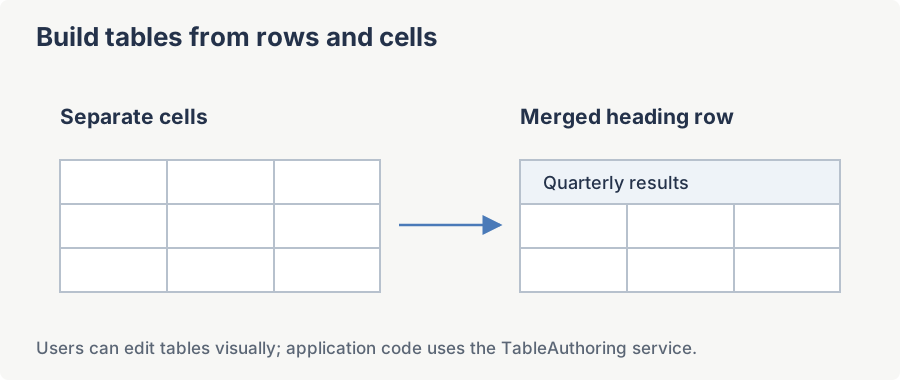
The table authoring service lets your application insert or remove rows and columns, merge cells and control table-editing guidelines. Use it to provide table commands in your own toolbar, ribbon or shortcuts. Access the service through Content.TableAuthoringService.
Namespace: SpiceLogic.HtmlEditor.Abstractions.Services.ElementAuthoring
Assembly: SpiceLogic.HtmlEditor.Abstractions.dll
Accessor: htmlEditor1.Content.TableAuthoringService
The service implements IDisposable; the editor owns its lifetime, so customer code never needs to call Dispose directly.
InsertColumn(InsertPositions position)
Inserts a new column adjacent to the table cell that currently contains the caret.
Syntax
void InsertColumn(InsertPositions position);Parameters
| Name | Type | Description |
|---|---|---|
| position | InsertPositions | Before inserts the new column to the left of the caret column; After inserts it to the right. |
Remarks
Silently does nothing unless the editor is in EditorModes.WysiwygDesign mode and the caret is inside a table cell.
Example
using SpiceLogic.HtmlEditor.Abstractions;
using SpiceLogic.HtmlEditor.Abstractions.Services.ElementAuthoring;

ITableAuthoringService tables = htmlEditor1.Content.TableAuthoringService;
// Insert a column to the right of the column under the caret.
tables.InsertColumn(InsertPositions.After);
Imports SpiceLogic.HtmlEditor.Abstractions
Imports SpiceLogic.HtmlEditor.Abstractions.Services.ElementAuthoring
Dim tables As ITableAuthoringService = htmlEditor1.Content.TableAuthoringService
' Insert a column to the right of the column under the caret.
tables.InsertColumn(InsertPositions.After)DeleteColumn()
Removes the column that contains the current cell from the table.
Syntax
void DeleteColumn();Remarks
Silently does nothing unless the editor is in EditorModes.WysiwygDesign mode and the caret is inside a table cell. If the column is the only column in the table, the entire table is removed.
Example
if (MessageBox.Show("Delete this column?", "Confirm", MessageBoxButtons.YesNo) == DialogResult.Yes)
{
    htmlEditor1.Content.TableAuthoringService.DeleteColumn();
}
If MessageBox.Show("Delete this column?", "Confirm", MessageBoxButtons.YesNo) = DialogResult.Yes Then
htmlEditor1.Content.TableAuthoringService.DeleteColumn()
End IfInsertRow(InsertPositions position)
Inserts a new row adjacent to the row that contains the caret.
Syntax
void InsertRow(InsertPositions position);Parameters
| Name | Type | Description |
|---|---|---|
| position | InsertPositions | Before inserts the new row above the caret row; After inserts it below. |
Remarks
Silently does nothing unless the editor is in EditorModes.WysiwygDesign mode and the caret is inside a table cell.
Example
// Hot-key handler for Ctrl+Enter -- append a new row below.
private void AppendRow_Click(object sender, EventArgs e)
{
    htmlEditor1.Content.TableAuthoringService.InsertRow(InsertPositions.After);
}
' Hot-key handler for Ctrl+Enter -- append a new row below.
Private Sub AppendRow_Click(sender As Object, e As EventArgs)
htmlEditor1.Content.TableAuthoringService.InsertRow(InsertPositions.After)
End SubDeleteRow()
Removes the row that contains the caret from the table.
Syntax
void DeleteRow();Remarks
Silently does nothing unless the editor is in EditorModes.WysiwygDesign mode and the caret is inside a table cell. If the row is the only row in the table, the entire table is removed.
Example
htmlEditor1.Content.TableAuthoringService.DeleteRow();MergeSelectedCells()
Merges the currently selected table cells into one. Styling on the resulting cell is inherited from the top-left source cell.
Syntax
void MergeSelectedCells();Remarks
The call is a no-op when CanMergeCells() returns false or when EnableTableCellMerging is false. Guard custom toolbar buttons with CanMergeCells() so their enabled state matches. Unlike the row and column operations above, this runs regardless of editor mode.
Example
var tables = htmlEditor1.Content.TableAuthoringService;
if (tables.CanMergeCells())
{
    tables.MergeSelectedCells();
}
Dim tables = htmlEditor1.Content.TableAuthoringService
If tables.CanMergeCells() Then
tables.MergeSelectedCells()
End IfShowGuidelinesForTablesWithZeroBorder(bool inBackground = false)
Renders a dashed guideline overlay around every table whose border attribute is 0. The guideline is purely a visual aid -- it is not serialized into the document HTML.
Syntax
void ShowGuidelinesForTablesWithZeroBorder(bool inBackground = false);Parameters
| Name | Type | Description |
|---|---|---|
| inBackground | bool | When true, the whole-document scan runs on a background thread instead of blocking the caller; a background call issued while a previous background pass is still running for the same operation is dropped rather than queued, and any exception is swallowed. Defaults to false, which runs synchronously on the caller's thread and lets any exception propagate. |
Remarks
Silently does nothing unless the editor is in EditorModes.WysiwygDesign mode. The guideline CSS is customizable via Options.ZeroBorderTableGuidelineCss.
Example
// Toggle the guideline overlay from a toolbar button.
htmlEditor1.Content.TableAuthoringService
    .ShowGuidelinesForTablesWithZeroBorder();
HideGuidelinesOfTablesWithZeroBorder(bool inBackground = false)
Removes the dashed guideline overlay added by ShowGuidelinesForTablesWithZeroBorder.
Syntax
void HideGuidelinesOfTablesWithZeroBorder(bool inBackground = false);Parameters
| Name | Type | Description |
|---|---|---|
| inBackground | bool | When true, the whole-document revert scan runs on a background thread instead of blocking the caller, with the same drop-if-already-running behavior as ShowGuidelinesForTablesWithZeroBorder. Defaults to false, which runs synchronously on the caller's thread and lets any exception propagate. |
Remarks
Silently does nothing unless the editor is in EditorModes.WysiwygDesign mode.
Example
htmlEditor1.Content.TableAuthoringService
    .HideGuidelinesOfTablesWithZeroBorder();
IsTableBorderZero(IHTMLElement tableElement)
Tests whether a given <table> element has an effective border of zero -- via the border="0" attribute or via CSS that resolves to no visible border.
Syntax
bool IsTableBorderZero(IHTMLElement tableElement);Parameters
| Name | Type | Description |
|---|---|---|
| tableElement | mshtml.IHTMLElement | The MSHTML <table> element to test. |
Returns
true when the table has no visible border; otherwise false.
Example
using mshtml;

var tables = htmlEditor1.Content.TableAuthoringService;
IHTMLElement selected = htmlEditor1.StateQuery.GetActiveHtmlElement();
if (selected?.tagName == "TABLE" && tables.IsTableBorderZero(selected))
{
    tables.ShowGuidelinesForTablesWithZeroBorder();
}
Imports mshtml
Dim tables = htmlEditor1.Content.TableAuthoringService
Dim selected As IHTMLElement = htmlEditor1.StateQuery.GetActiveHtmlElement()
If selected?.tagName = "TABLE" AndAlso tables.IsTableBorderZero(selected) Then
tables.ShowGuidelinesForTablesWithZeroBorder()
End IfCanMergeCells()
Reports whether the current selection covers two or more adjacent cells eligible for merging.
Syntax
bool CanMergeCells();Returns
true when cells can be merged; otherwise false.
Remarks
Bind this to the Enabled of a custom Merge-Cells toolbar button inside SelectionChanged so the button greys out automatically when merging is not possible.
Example
htmlEditor1.SelectionChanged += (s, e) =>
{
    mergeButton.Enabled = htmlEditor1.Content.TableAuthoringService.CanMergeCells();
};
GetTableManipulator()
Returns the ITableManipulator state-query helper, created once per document the first time it is requested and cached from then on -- it is not re-created per call or scoped to the caret. Its public surface is a single state-query member, CanMerge(), which CanMergeCells forwards to.
Syntax
ITableManipulator GetTableManipulator();Returns
The current ITableManipulator instance. It is never null, regardless of caret position; call ResetTableManipulator to force a fresh instance.
Example
var manipulator = htmlEditor1.Content.TableAuthoringService.GetTableManipulator();
Debug.WriteLine($"Selection can be merged: {manipulator.CanMerge()}");
Dim manipulator = htmlEditor1.Content.TableAuthoringService.GetTableManipulator()
Debug.WriteLine($"Selection can be merged: {manipulator.CanMerge()}")ResetTableManipulator()
Immediately disposes the cached ITableManipulator and creates a fresh one, rather than deferring the re-creation to the next GetTableManipulator call. Call this after a programmatic edit you suspect invalidated the cached state -- for example, after replacing the document HTML wholesale.
Syntax
void ResetTableManipulator();Remarks
This also re-derives EnableTableCellMerging from Options.EnableTableCellMerge, discarding any value set directly on the property beforehand.
Example
htmlEditor1.Content.SetBodyHtml("<table border=\"1\"><tr><td>A</td></tr></table>");
htmlEditor1.Content.TableAuthoringService.ResetTableManipulator();
SelectedCellBackgroundColor Property
Gets or sets the background color used to highlight selected table cells on the editor surface. This is a UI-only highlight; it does not emit a background-color style on the cells themselves.
Syntax
Color SelectedCellBackgroundColor { get; set; }Property Value
A System.Drawing.Color. The default is a light-blue overlay; pick any color that contrasts with your document background.
Example
using System.Drawing;

htmlEditor1.Content.TableAuthoringService.SelectedCellBackgroundColor = Color.FromArgb(120, 255, 230, 0); // semi-transparent yellow
Imports System.Drawing

htmlEditor1.Content.TableAuthoringService.SelectedCellBackgroundColor = Color.FromArgb(120, 255, 230, 0) ' semi-transparent yellow
EnableTableCellMerging Property
Gets or sets whether the cell-merging feature is enabled. When false, MergeSelectedCells is a no-op and the editor suppresses any cell-selection UI.
Syntax
bool EnableTableCellMerging { get; set; }Property Value
true to allow cell merging; false to disable it. This is initialized from Options.EnableTableCellMerge at startup, and again every time ResetTableManipulator runs.
Example
// Disable cell merging for a simplified authoring mode.
htmlEditor1.Content.TableAuthoringService.EnableTableCellMerging = false;
' Disable cell merging for a simplified authoring mode.
htmlEditor1.Content.TableAuthoringService.EnableTableCellMerging = FalseAsk your AI to do this
Connect the SpiceLogic MCP server, then give your coding assistant this prompt.
I use the SpiceLogic WinForms HTML Editor. Help me drive row, column and cell operations from my application toolbar. Confirm the exact API names, types and defaults with the SpiceLogic MCP documentation, then show the changes for my project.