


What Is AHP? The Analytic Hierarchy Process Explained
The Analytic Hierarchy Process (AHP) is a method for making decisions when several factors matter at the same time. Instead of trying to keep every trade-off in your head, you break the decision into a clear hierarchy, compare items two at a time, and let the math calculate a priority ranking.
AHP is useful when a decision has both numbers and judgment. For example, buying a car may involve price, safety, comfort, fuel cost, and reliability. Some of those can be measured directly. Others are based on preference or expert judgment. AHP gives you a structured way to combine them.
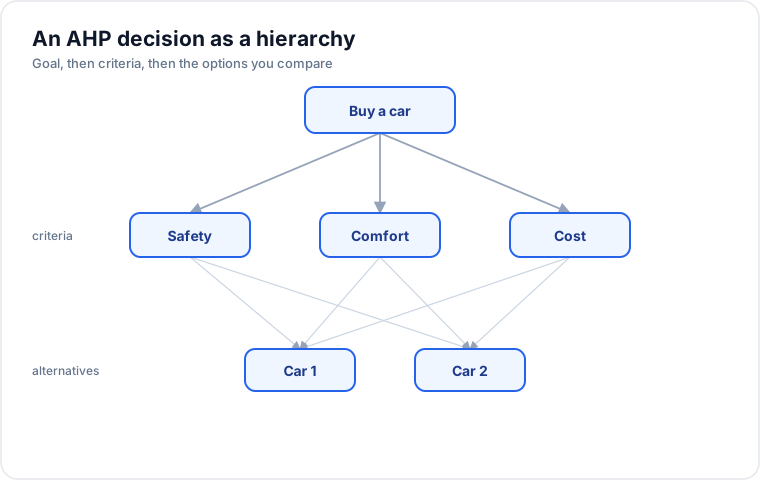
The Basic AHP Structure
An AHP model has three common levels:
1. Goal: what you are trying to decide.
2. Criteria: the factors that matter in the decision.
3. Alternatives: the options you are choosing between.
For a car-selection example, the goal may be "Buy a car". The criteria may be Safety, Comfort, and Cost. The alternatives may be Car 1 and Car 2.
Why Pairwise Comparison Helps
AHP asks you to compare two items at a time. This is easier than ranking many items all at once. For example, instead of asking "How important are Safety, Comfort, and Cost together?", AHP asks questions like "How much more important is Safety than Comfort?"
The judgment is usually entered on the Saaty 1 to 9 scale. A value of 1 means the two items are equally important. Larger values mean one item is preferred more strongly than the other.
How AHP Produces Weights
The pairwise comparisons form a matrix. From that matrix, AHP calculates priority weights. Those weights show the relative importance of each criterion or the relative preference of each alternative under a criterion.
For example, after comparing Safety, Comfort, and Cost, the model may calculate that Cost has a weight of 0.67, Safety has a weight of 0.23, and Comfort has a weight of 0.10. These values add up to 1.
Consistency Check
AHP also checks whether your comparisons are reasonably consistent. If you prefer A over B, and B over C, the comparison between A and C should make sense with those earlier judgments. The consistency ratio helps you spot when the comparisons may need review.
A common guideline is to keep the consistency ratio at or below 0.1. This is not a magic rule, but it is a practical warning sign. If the value is high, review the comparisons before trusting the final ranking.
How SpiceLogic AHP Software Fits In
SpiceLogic AHP Software walks you through the model with a wizard. You define the goal, add criteria and alternatives, make pairwise comparisons, review the consistency ratio, and then read the final priority ranking. The software also provides charts and sensitivity analysis so you can see how stable the recommendation is.
For a full walkthrough, start with the step-by-step AHP example.