


AHP Formula: Priority Weights and Consistency Ratio
This page explains the main formulas used in the Analytic Hierarchy Process (AHP). The goal is not to make the math look complicated. The goal is to show how pairwise judgments become priority weights, and how the consistency ratio is calculated.
1. Pairwise Comparison Matrix
Suppose you are comparing n criteria. The pairwise comparison matrix A is an n by n matrix. Each value a(i,j) represents how strongly item i is preferred over item j.
The diagonal values are always 1 because each item is equal to itself. The matrix is reciprocal, so if a(i,j) = 5, then a(j,i) = 1/5.
2. Priority Weights
The priority vector w contains the relative weights of the criteria. The weights are usually normalized so they add up to 1.
One common approximation method is:
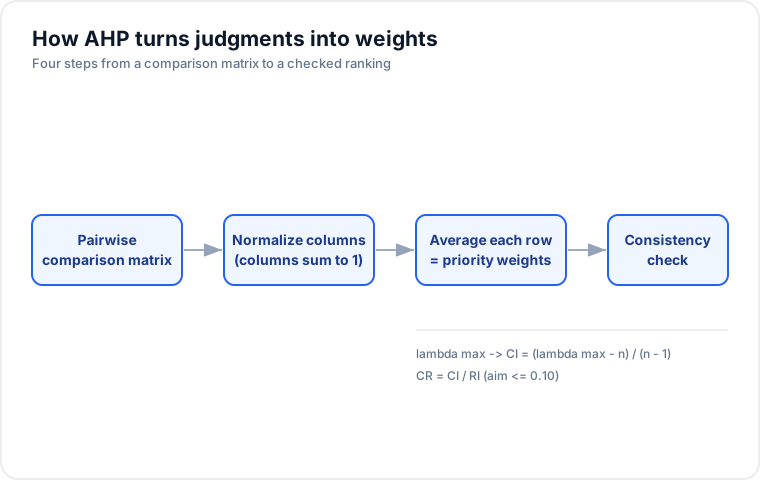
Step 1: Add each column of the pairwise comparison matrix.
Step 2: Divide each cell by its column sum. This creates a normalized matrix.
Step 3: Average each row of the normalized matrix. The row averages are the priority weights.
The geometric mean method is another common option:
Step 1: Multiply the values in each row.
Step 2: Take the nth root of that product.
Step 3: Normalize the resulting values so their sum is 1.
3. Lambda Max
After you have the priority vector, multiply the pairwise comparison matrix by the priority vector. Then divide each value in that result by the matching priority weight. The average of those values is lambda max.
For a perfectly consistent matrix, lambda max equals n. As inconsistency increases, lambda max moves above n.
4. Consistency Index
The Consistency Index (CI) is calculated with this formula:
CI = (lambda max - n) / (n - 1)
Here, n is the number of items in the matrix.
5. Random Index
The Random Index (RI) is a reference value based on the matrix size. It represents the expected inconsistency of a randomly filled matrix. A 3 by 3 matrix commonly uses RI = 0.58.
6. Consistency Ratio
The Consistency Ratio (CR) is calculated with this formula:
CR = CI / RI
A common guideline is that CR should be less than or equal to 0.1. If the value is higher, review the pairwise comparisons and look for judgments that do not fit the rest of the model.
Where the Software Shows These Values
SpiceLogic AHP Software calculates the priority weights and consistency ratio while you work. You can also switch calculation methods, compare results, and use the consistency page to inspect the numbers in more detail.
For the software walkthrough, see AHP Calculation Methods and AHP Consistency Ratio.