


 NuGet
NuGet
Keep custom buttons in sync
A formatting button should reflect the text at the caret: Bold should appear pressed on bold text, and table commands should be available when relevant. Handle SelectionChanged and query StateQuery to keep your own buttons in step with the current selection.
The two members that solve this
Two members on WinFormHtmlEditor handle it. The event SelectionChanged fires whenever the caret moves or the selection changes: typing, arrow keys, mouse clicks, paste, or a programmatic edit. The service StateQuery, an IStateQueryService, is the same service the built-in toolbar uses to drive its own pressed-state logic. Hook the event, query the service on each fire, and update your controls.
private void ManuscriptForm_Load(object sender, EventArgs e) {
    htmlEditor1.SelectionChanged += HtmlEditor_SelectionChanged;
}

private void HtmlEditor_SelectionChanged(object sender, EventArgs e) {
    var sq = htmlEditor1.StateQuery;
    // Toggle pressed state on the ribbon buttons.
    ribbonBoldButton.Checked = sq.IsBold();
    ribbonItalicButton.Checked = sq.IsItalic();
    ribbonUnderlineButton.Checked = sq.IsUnderline();
    // Highlight Insert Image when an image is the active element.
    ribbonImageButton.BackColor = sq.IsImage() ? SystemColors.Highlight : SystemColors.Control;
    // Show the active font in the status bar.
    lblActiveFont.Text = sq.GetActiveFontFamilyName();
    lblActiveSize.Text = sq.GetActiveFontSize();
}
Private Sub ManuscriptForm_Load(sender As Object, e As EventArgs)
AddHandler htmlEditor1.SelectionChanged, AddressOf HtmlEditor_SelectionChanged
End Sub
Private Sub HtmlEditor_SelectionChanged(sender As Object, e As EventArgs)
Dim sq = htmlEditor1.StateQuery
' Toggle pressed state on the ribbon buttons.
ribbonBoldButton.Checked = sq.IsBold()
ribbonItalicButton.Checked = sq.IsItalic()
ribbonUnderlineButton.Checked = sq.IsUnderline()
' Highlight Insert Image when an image is the active element.
ribbonImageButton.BackColor = If(sq.IsImage(), SystemColors.Highlight, SystemColors.Control)
' Show the active font in the status bar.
lblActiveFont.Text = sq.GetActiveFontFamilyName()
lblActiveSize.Text = sq.GetActiveFontSize()
End Sub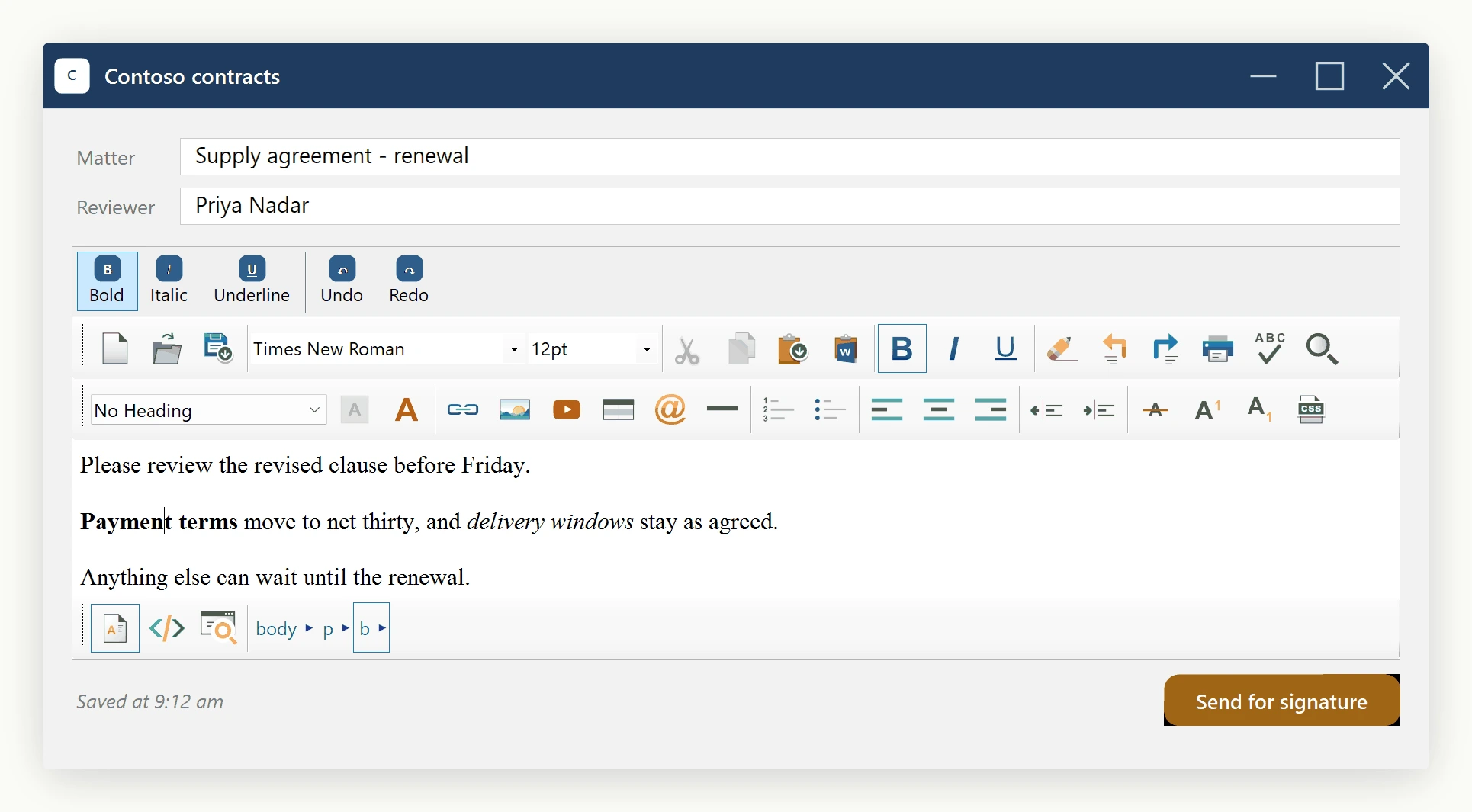
What StateQuery exposes
The IStateQueryService interface exposes the current editor state so you can keep toolbar/ribbon buttons in sync with the selection, without polling.
- Inline formatting:
IsBold(),IsItalic(),IsUnderline(),IsStrikeThrough(),IsSuperscript(),IsSubscript(). - Block formatting:
IsOrderedList(),IsUnorderedList(),IsJustifyLeft(),IsJustifyCenter(),IsJustifyRight(),IsActiveElementHeaderTitle(),GetActiveHeaderTitleNumber(). - Active element kind:
IsHyperLink(),IsImage(),IsTable(),IsTableCell(),IsYouTubeVideo(),IsActiveOrAncestorElementTable(),IsActiveOrAncestorElementHyperLink(). - Font:
GetActiveFontFamilyName(),GetActiveFontSize(),GetActiveForeColor(),GetActiveHighlightColor(). - Edit-state guards:
CanUndo(),CanRedo(),CanCut(),CanCopy(),CanPaste(),CanDelete(),CanMergeTableCells(). - Low-level access:
GetActiveHtmlElement()returns the rawIHTMLElementwhen the high-level helpers don't cover an attribute you need.
Driving Undo/Redo enabled state
Undo and Redo buttons should only be enabled when there is actually something to undo or redo. Extend the same SelectionChanged handler:
private void HtmlEditor_SelectionChanged(object sender, EventArgs e) {
    var sq = htmlEditor1.StateQuery;
    ribbonBoldButton.Checked = sq.IsBold();
    ribbonItalicButton.Checked = sq.IsItalic();
    ribbonUnderlineButton.Checked = sq.IsUnderline();
    ribbonUndoButton.Enabled = sq.CanUndo();
    ribbonRedoButton.Enabled = sq.CanRedo();
    ribbonPasteButton.Enabled = sq.CanPaste();
}
Private Sub HtmlEditor_SelectionChanged(sender As Object, e As EventArgs)
Dim sq = htmlEditor1.StateQuery
ribbonBoldButton.Checked = sq.IsBold()
ribbonItalicButton.Checked = sq.IsItalic()
ribbonUnderlineButton.Checked = sq.IsUnderline()
ribbonUndoButton.Enabled = sq.CanUndo()
ribbonRedoButton.Enabled = sq.CanRedo()
ribbonPasteButton.Enabled = sq.CanPaste()
End Sub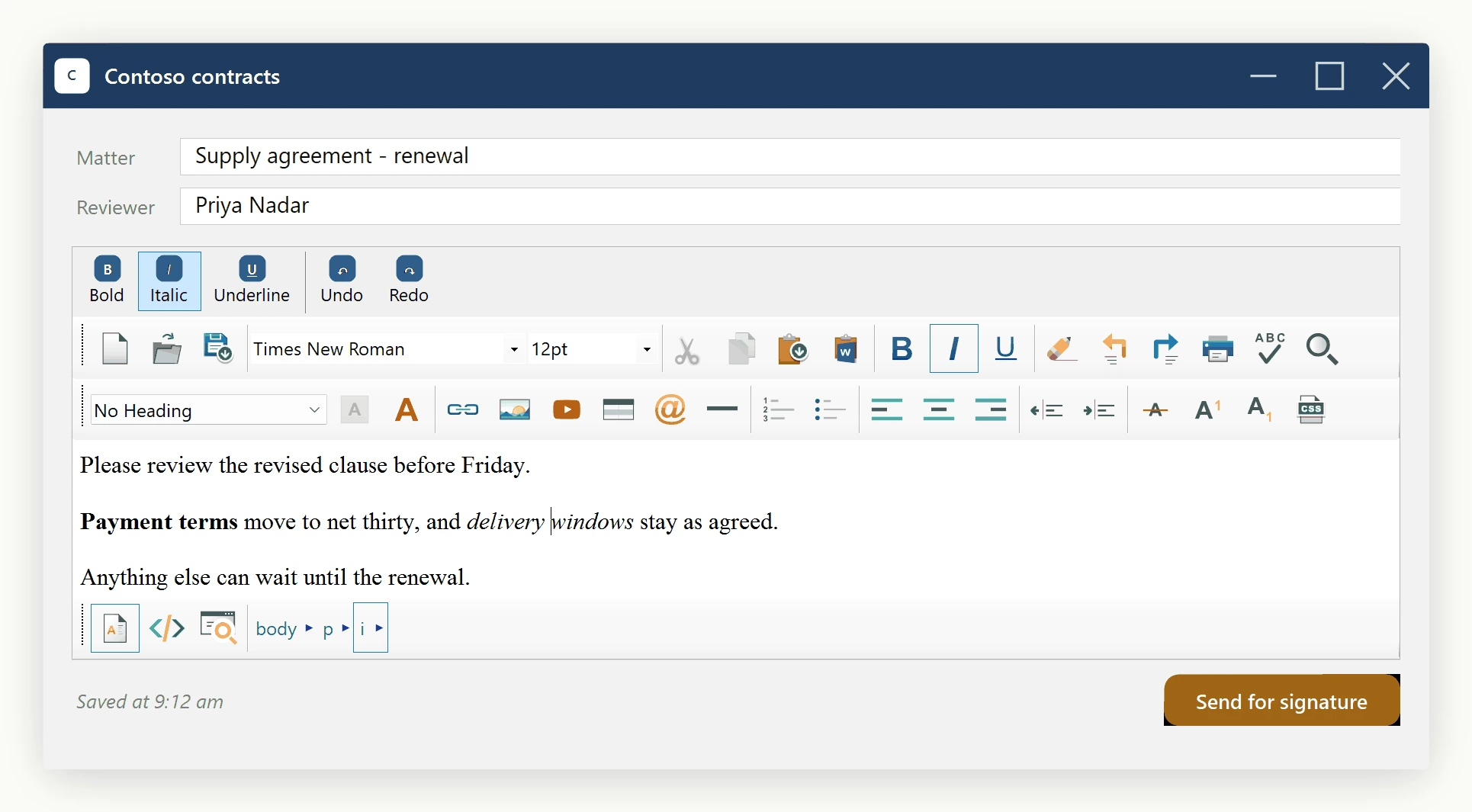
The performance footnote
The SelectionChanged handler can fire often, so keep it cheap. Calls into StateQuery are inexpensive, but avoid anything heavy inside the handler: no network calls, no file I/O, and no layout-triggering reflows of large panels. If a reaction to selection changes cannot run synchronously, defer it to a short-debounce System.Windows.Forms.Timer so long edit sessions don't stutter.
Ask your AI to do this
Connect the SpiceLogic MCP server, then give your coding assistant this prompt.
I use the SpiceLogic WinForms HTML Editor. Help me keep my custom formatting buttons in sync with the current selection. Confirm the exact API names, types and defaults with the SpiceLogic MCP documentation, then show the changes for my project.